A completed Tetriamantic chart can look like a lot.
There are fifteen figures, several kinds of positions, and many possible relationships among them.
Do not try to interpret everything at once.
The chart is easiest to read by moving from the simplest parts toward the whole.
1. Begin with the Four Sources
Start with:
- A: Will
- B: Encounter
- C: Form
- D: Actuality
Read each figure from its four parts:
- What is manifest?
- What is liminal?
- What is latent?
- What does that tell you about the position it occupies?
For example, if A contains manifest Fire but latent Earth, Will may be clearly expressed while action remains unrealized.
Do the same for B, C, and D.
At this point, you should already have the beginnings of a story.
2. Read the Bounds
Next, look at the six Bounds:
AB, AC, AD, BC, BD, CD
These tell you what happens between the Sources.
You do not need to interpret them as entirely new subjects.
Instead, use them to ask questions such as:
- How is Will relating to Encounter?
- How is Form becoming Actuality?
- What happens when Will meets material reality?
The Bound helps explain the relationship you were already seeing in the Sources.
3. Read the Fields
The four Fields are:
ABC, ABD, ACD, BCD
Each combines three Sources into a larger environment.
A useful shortcut is to notice what each Field leaves out.
- ABC excludes Actuality.
- ABD excludes Form.
- ACD excludes Encounter.
- BCD excludes Will.
This can reveal what the situation looks like when one part of it is removed from consideration.
Do not overcomplicate this.
Ask:
What larger pattern do these three parts create together?
4. Finish with the Whole
Finally, read ABCD.
ABCD represents the entire situation considered together.
It is not there to erase everything you have already read.
It summarizes it.
Ask:
What condition does the whole chart create?
If your interpretation of ABCD seems completely unrelated to everything else, go back and check your earlier reading.
Usually, the Whole should feel less like a surprise and more like the final sentence of something you have already been reading.
Look for Repetition
As you move through the chart, notice what keeps happening.
Maybe:
- Fire is repeatedly manifest;
- Earth is repeatedly latent;
- several positions remain liminal;
- the same figure appears more than once;
- one part of the chart seems much more settled than another.
Repeated patterns usually matter more than isolated details.
You are looking for the chart’s grammar, not collecting fifteen unrelated definitions.
Build the Reading as You Go
A useful way to think about the process is:
- Sources tell you what is present.
- Bounds tell you how those things relate.
- Fields tell you what larger patterns they create.
- The Whole tells you what the situation amounts to.
That is enough to perform a reading.
You do not need to understand every possible correspondence, memorize all 81 figures, or produce a paragraph for every position.
Start with the parts.
Let them build on one another.
By the time you reach ABCD, you should not be trying to invent an interpretation.
You should be recognizing the one the chart has already been showing you.
An Example Reading
Consider this chart:
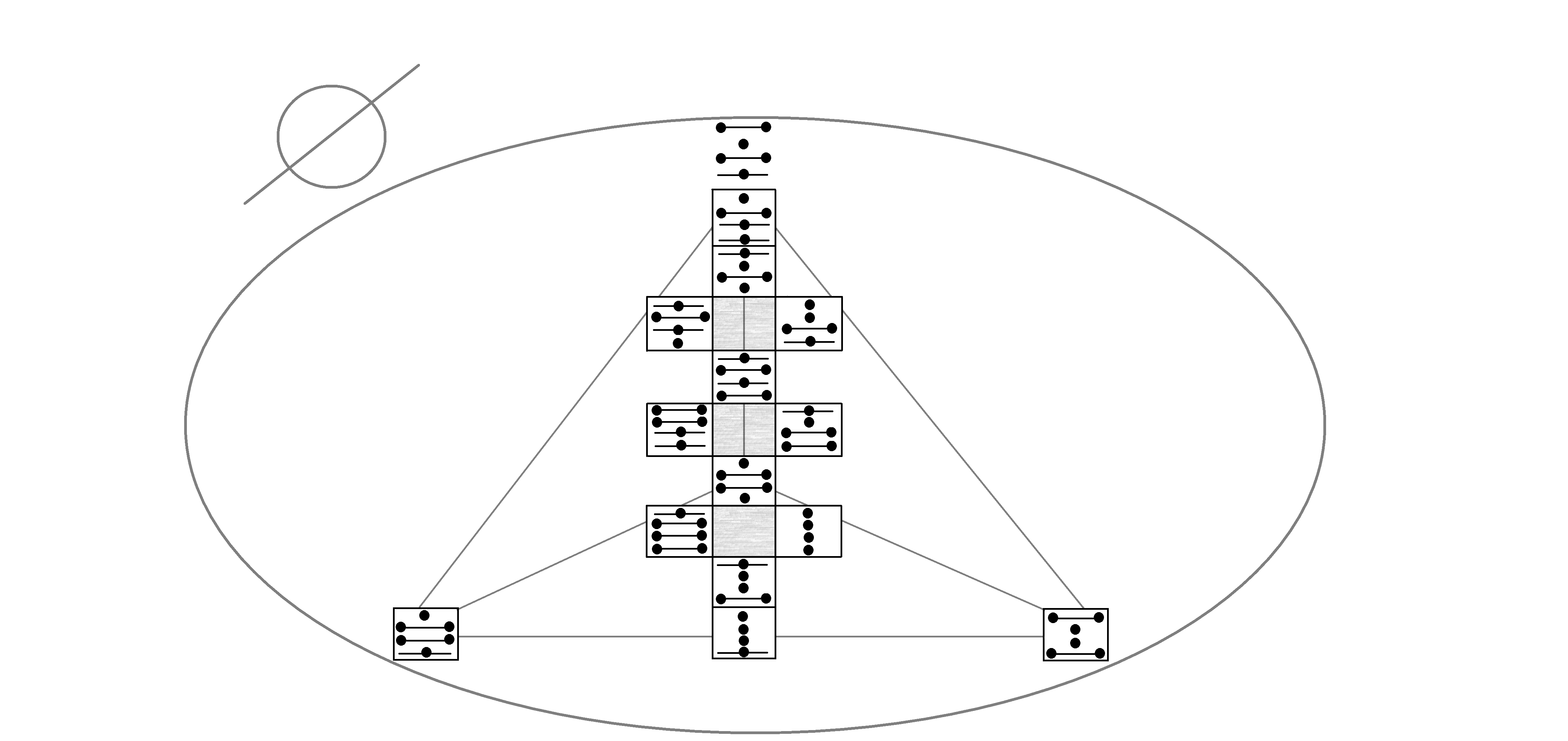
Assume you were to want to perform a general reading of your circumstances or someone else’s—just a general, “What is my situation?”
Begin with the four Sources.
At A: Will, Fire is latent and Air is liminal, while Water and Earth are manifest. Something is already being felt and done before the intention behind it has become completely clear. Will exists, but it has not yet fully declared itself.
At B: Encounter, Fire and Earth are latent while Air and Water are liminal. The encounter itself remains unsettled. There is not yet a definite response or course of action; understanding and experience are still developing.
At C: Form, nothing is manifest. Fire and Earth are liminal while Air and Water remain latent. The situation has not yet found a stable form. Something is beginning to take shape, but it cannot yet be clearly explained or experienced as complete.
At D: Actuality, Earth is manifest while Fire is latent and Air and Water are liminal. Something is already materially happening even though its purpose, meaning, and emotional significance remain unresolved.
Already, a pattern appears:
Reality is moving faster than understanding.
The Bounds reinforce this.
At AB: Will and Encounter, Fire and Water are manifest while Air and Earth remain liminal. Contact with the situation strongly activates desire and feeling, but what it means and what should follow from it are still developing.
At BC: Encounter and Form, all four parts are latent. Experience has not yet found a form. Whatever is being encountered has not become a clear idea, interpretation, value, or possibility.
At CD: Form and Actuality, Earth alone is manifest. Something has become concrete before the Will, reasoning, or experience surrounding it has fully taken shape.
Finally, ABCD: the Whole has liminal Fire, latent Air, liminal Water, and manifest Earth.
The situation as a whole is therefore real and already in motion, but its purpose and emotional meaning are still changing, while a coherent explanation remains largely absent.
The chart does not describe paralysis.
It describes a situation that has become actual before everyone involved fully understands what it is.
The strongest advice from the structure would be not to mistake lack of understanding for lack of movement. Something is already happening. The task may be to observe what has become real and allow the meaning of it to catch up.